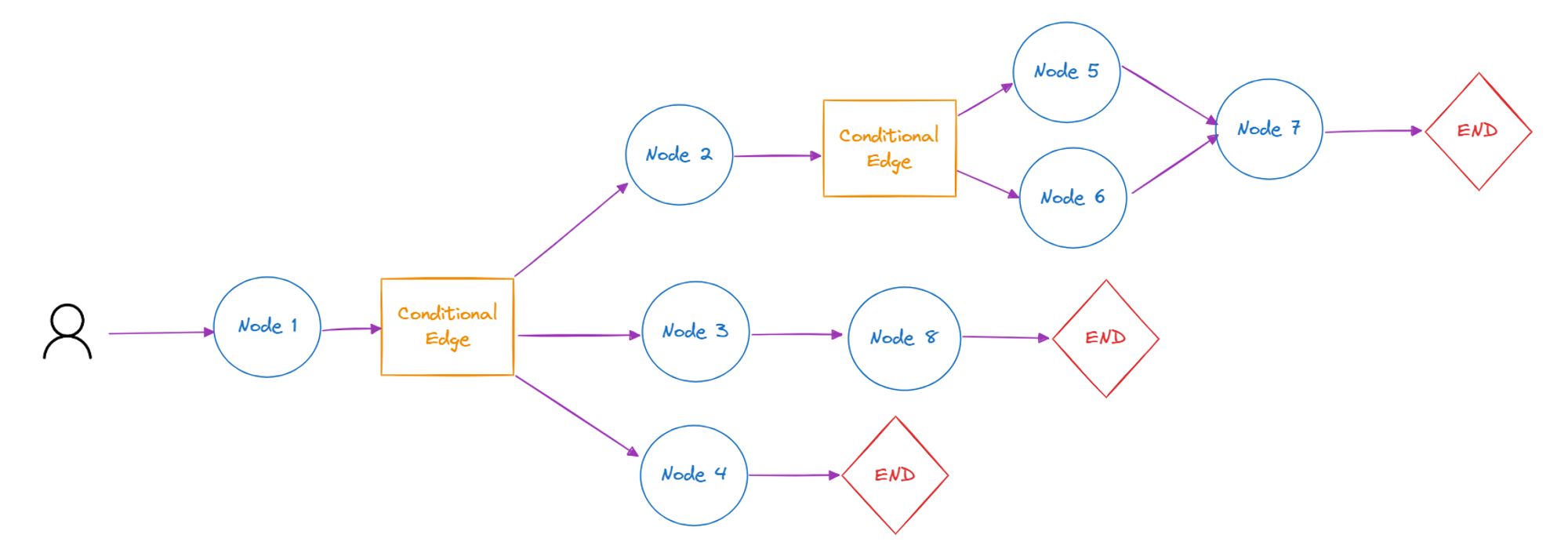
As agentic systems become more capable, how we structure their workflows matters as much as the models themselves. One pattern we rely on at Softrobot is the graph, where each node reflects a concrete action or decision in the agent’s process. This isn’t off-the-shelf orchestration. It’s an in-house system, purpose-built around the idea of representing the agent’s evolving context as it runs. Here’s why that structure works, and how we apply it to get the most of what matters.
As agentic systems become more capable, how we structure their workflows matters as much as the models themselves. One pattern we rely on at Softrobot is the graph, where each node reflects a concrete action or decision in the agent’s process. This isn’t off-the-shelf orchestration. It’s an in-house system, purpose-built around the idea of representing the agent’s evolving context as it runs. Here’s why that structure works, and how we apply it to get the most of what matters. 1. Dynamic, Transparent, and Traceable Large models are often considered black boxes. We can’t always see how they reason, but we can structure what they’re reasoning about. Graphs give us that scaffolding. Each node represents a clear step: a retrieval, a judgment, a decision point. That containment makes the system’s flow legible, even when the model’s internals aren’t. The result is a process we can follow, inspect, and debug. By using a graph, we don’t only guide the model but we give its choices meaning. 2. Built for Agentic Complexity Agentic systems rarely move in one direction. They revisit, retry, adapt. In that way, graphs are a natural fit for this kind of capricious behaviour. Rather than relying on brittle conditionals or deeply nested logic, we use the graph with loops, branches, and fallbacks already built-in. This structure is currently being used in more complex scenarios from multi-agent workflows and adaptive planning to long-horizon reasoning. That’s because teams see the graph for what it is: a live map of how the system navigates uncertainty. 3. Lightweight by Design We’re intentional about where we use graphs. Not every function needs its own node. Overengineering leads to unnecessary complexity, more orchestration, and a migraine to maintain.The best systems balance structure and simplicity. We use a high-level graph to frame the agent’s behavior, with focused logic inside each step. That separation keeps things flexible and clear. And clarity wins. Always. 4. Where It’s Headed Graphs are the connective tissue between modern AI capabilities and proven software principles. They bring order to systems that reason in open-ended ways. As agents become more autonomous, we rely on graphs to provide explainability, composability, and control. They don’t replace the model, they frame its behavior. We don’t use graphs to model knowledge. We use them to shape process. That’s how we trace reasoning, guide behavior, and iterate safely at Softrobot. Used well, the graph stays in service to the system, not the other way around, and that’s exactly how we like it.

Drew Perkins

Let's work together
Ready to transform your data and AI capabilities? Get in touch with our team to explore how we can help.
Contact us